PEP725, the Pan European Phenological Database (Templ et al., 2018) is a European research infrastructure to promote and facilitate phenological research. Its main objective is to build up and maintain a pan European phenological database with an open, unrestricted data access for science, research and education. So far more than 20 European meteorological services and 7 partners from different phenological network operators have joined PEP725, a follow up of COST725 (Koch et al.,2009).
In many European countries, phenological observations have been collected during the last decades by different governmental and non-governmental organisations while following various observation guidelines. Therefore, data have been stored at different places in different formats. This has been hampering large scale studies, because the researcher had to approach each individual network operator for the data, then convert and compile them in a data base.
www.pep725.eu has been developed to solve these problems by offering a single entry point to more than 16 million phenological records, all of them classified according to the so called BBCH scale. The first datasets in PEP725 date back to 1868; however, there are only a few observations available until 1950. Having accepted the PEP725 data policy and finished the registration, the data download is quick and easy. Within PEP725 scientists can find observations of 151 different plants (plus 91 cultivars) separated into 97 phenological phases from many parts of Europe. The observation programs differ between the partners as well the monitored plants. Researchers are supplied with records of native and invasive species, trees and crops. About 90% of all records were provided from the German Phenological Network (operated by DWD), followed by observations from Austria, Sweden, the United Kingdom and Switzerland. Most of the countries submit their records once a year after they’ve finished the final quality checks.
PEP725 does not operate its own observation programme; we rely on our partners who run national and cross-border phenology programmes.
The following national meteorological services, networks and institutions participate or have participated in the PEP725 programme.
The following National Meteorological Services, Networks and Institutions have participated in the PEP725 Programme.
How it all began – celebrating 15 Years of this Phenological Research Infrastructure.
A brief review of the origins of PEP725
In the late 1990s, phenology came into focus as an indicator of climate change.
POSITIVE (Phenological Observations and Satellite Data (NDVI) – Trends in the Vegetation Cycle in Europe) was one of the first major phenological projects initiated in Europe. The project ran from 2000 to 2002 under the Fifth EU Framework Programme, with the participation of the International Phenological Gardens, the national phenological networks of the German, Swiss, Austrian and Estonian weather services, and others.
Only two years later, in 2004, COST 725 – Establishing a European Phenological Data Platform for Climatological Applications (led by Elisabeth Koch / ZAMG) was launched. The focus was to establish a European reference dataset of phenological observations that can be used for climatological purposes, in particular for climate monitoring and detection of changes.
The results of this COST Action were published in a booklet ‘The history and current status of plant phenology in Europe’ – an extract of which was even included in the Fourth IPCC Assessment Report, 2007.
At the end of COST 725, a large amount of data was available – a waste to store it only on a hard disk. Many of the former project members are committed to making this data set available for further research and, if possible, to continue to add new observations.
PEP725 does not operate its own observation programme; we rely on our partners who run national and cross-border phenology programmes. The following National Meteorological Services, Networks and Institutions participate in the PEP725 Programme.
A brief review of the origins of PEP725
In the late 1990s, phenology came into focus as an indicator of climate change.
POSITIVE (Phenological Observations and Satellite Data (NDVI) – Trends in the Vegetation Cycle in Europe) was one of the first major phenological projects initiated in Europe. The project ran from 2000 to 2002 under the Fifth EU Framework Programme, with the participation of the International Phenological Gardens, the national phenological networks of the German, Swiss, Austrian and Estonian weather services, and others.
Only two years later, in 2004, COST 725 – Establishing a European Phenological Data Platform for Climatological Applications (led by Elisabeth Koch / ZAMG) was launched. The focus was to establish a European reference dataset of phenological observations that can be used for climatological purposes, in particular for climate monitoring and detection of changes.
The results of this COST Action were published in a booklet ‘The history and current status of plant phenology in Europe’ – an extract of which was even included in the Fourth IPCC Assessment Report, 2007.
At the end of COST 725, a large amount of data was available – a waste to store it only on a hard disk. Many of the former project members are committed to making this data set available for further research and, if possible, to continue to add new observations.
The era of PEP725
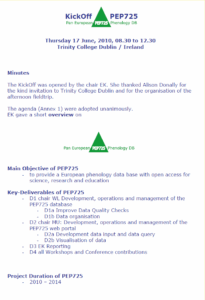
Work began in 2009 to continue the successful collaboration. The first meetings were held and the search for a sponsor started. The official birth of PEP725 took place almost a year later on 17. June 2010 at the Phenology 2010 conference in Dublin, Ireland. Funding for the first project phase from 2010 – 2014 was secured by EUMETNET and ZAMG (now GeoSphere Austria).
During the past 15 years, PEP725 has collected and prepared more than 13 million plant phenological observations and made them available for research.
We are extremely grateful to the organisations listed in the title, as well as the 30,000+ observers behind them who have dedicated their precious time and energy to collect all this records.
Some highlights
It was a gradual transition from a data-only project to the formation of a small but very fine PEP725 community. Through our annual meetings in Vienna, more than just a professional exchange of ideas has been established.
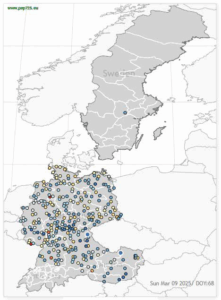
Within PEP725, the first real-time phenology monitor for Europe was put online. Unfortunately, it remained with the original contributors (Germany, Austria, Switzerland, Sweden) and we were unable to expand the sub-project to other countries.
There is still a lot of interest in data about the timing of natural events from whole of Europe. Since 2011, we have recorded more than 160,000 downloads (which is about 2.4 billion observations).
But how can we measure the success of a scientific project if not by the number of publications it generates? I think PEP725 has filled this gap by providing a data platform for Europe. Without it, many of the currently 142 reviewed articles would not have been published.